Rodrigo Cruz: Women Warriors

Photo © Rodrigo Cruz-All Rights Reserved

The reason I go out onto the streets with my camera is simple: I want to tell people's stories in an intimate way through powerful imagery. -Roberto Cruz

Rodrigo Cruz is a freelance photographer with a particular interest in abuses of human rights, especially against women and children in his native Mexico. His work was published by National Geographic and The Washington Post, and by NGOs such as Amnesty International. He was shortlisted for the 2010 Anthropographia Award for Photography and Human Rights; received an honorary mention in the photo contest ‘Global World: through the lens of human rights’; and was selected last year to participate in PhotoEspaƱa’s Descubrimientos in Guatemala City.

I met Roberto at the inaugural Foundry Photojournalism Workshop in Mexico City in 2008, and he was one of the indispensable members that made it such a success. Many of the photojournalists, whether instructors or students, relied on his knowledge, contacts and assistance for their projects and classes.

Have a look at Rodrigo's Women Warriors and Dance of Mice; these are two unusual traditions practiced in Guerrero in southern Mexico. One of his audio-slideshow projects especially relevant at this time when illegal immigration is being targeted in our southern states is The Promised Land.

For further details on Rodrigo, his projects and talent, drop by Canon Pro Network.

Next Week on The Travel Photographer


For the week starting Monday October 25, I planned posts on:

1. A photo essay on the Tibetans living in India, that was supposed to be on last week.
2. A remarkable web documentary (multimedia) on China that will leave you speechless.
3. A short movie on Egypt made on a Canon 5D MarkII...very well done.
4. The work of a photographer documenting musicians of the Mississippi Delta...with my kind of music...really hard core Blues.
5. The work of a photojournalist documenting African wrestlers.

A Look At The Zoom H1


I've blogged a couple of times about the H1, the new handheld audio recorder from Samson Audio, and what seemed to be a handy portable stereo recorder at an unheard-of $99 price.

I haven't bought the H1 (as I already have a Marantz PMD 620 which I'm happy with), but a number of my readers have expressed their interest in seeing a review...so the above movie by Shawn Harrel will do just that.

As I expected, the H1 seems to feel a little flimsy, it has a few quirks, but does the job quite well. The price can't be beaten, so I predict I'll see it used by emerging photojournalists on a budget testing multimedia waters.

Speaking of multimedia: I have my new Canon 7D next to me as I'm writing this, but I have yet to really test it. I've ignored the manual as always, fiddled with it and so far it's quite intuitive, especially to a long time Canon user like I am. I'll be putting up some photographs as soon as I can...but one thing for sure: the 8fps is great!


In the meantime, I've added this cheap rig to my 5D Mark II. It's my Marantz audio-recorder attached to a standard mounting plate from Home Depot, which in turn is attached to the camera's tripod socket. From my Mamiya medium-format years, I had an old Hama grip that I also attached to the tripod socket, and it gives me much better control over the camera when I'm filming video.

All I need now is the LCDV.

Khaled Hasan: Death of Dreams

Photo © Khaled Hasan-All Rights Reserved

Khaled Hasan is a Bangladeshi freelance photographer, whose work appeared in several daily newspapers in Bangladesh and international Magazines, such as Sunday Times Magazine, American Photo, National Geographic Society, Better Photography, Saudi Aramco World Magazine, Guardian, Telegraph, The Independent and The New Internationalist.

He was awarded the 2008 All Roads Photography Program of National Geographic Society, as well as the Alexia Foundation Student Award (Award of Excellence). He has been recognized with several awards including the Humanity Photo Documentary Award.

Khaled believes in immersion photography, and listens, observes and talks with his subjects over an extended period of time. In Death of Dreams, he focused on Dhaka's largest old-age home called Boshipuk, and followed the daily lives of the residents for two years.

His photo essay documents the effect of modernization on the traditional structure of Bangla families, and which leads to old ways and values being discarded. Elderly parents are now forced to live out their old age alone, and face living the remaining of their lives in impersonal surroundings.

Via GlobalPost's Full Frame.

A Storyboard Template

Following my earlier post on my handwritten storyboard doodles I used for one of my audio-slideshows, I thought I'd prep one that looked a little more sophisticated, and could serve as a template. The templates I found on the internets were not exactly what I wanted, so I basically created one using an existing Excel template.

So here's The Travel Photographer's exclusive storyboard template (PDF) available as a free download to anyone who needs it. I hope you'll find it useful to plan and set up your slideshows.

Is it better than the doodly one?

The Fish Farm at Kilim Geoforest Park of Langkawi Island

The Fish Farm (N6 24.945 E99 51.821) is located at the same area of The Hole In The Wall Floating Restaurant along the Kilim River of Langkawi Island. This activity was part of the Mangrove Tour.

The Fish Farm

The farm was not huge but it was enough for us to see all the big fishes around...
The young boy who speak fluent English had became our tour guide and started to showed us around the farm.
At first, he showed us the 'Shooting Fish' which was really interesting!

The Shooting Fish

There were many big fishes in the farm! Like this one below...

Then the boy brought us to the Stingray area, and all the rays seems like waiting at the site!

The big Black Ray!

Then the boy started to feed them with pieces of fish...

The black rays were Really Hungry!! :)

The rays overturned 

The boy continued to feed the hungry rays, and he overturn the body and showed us where is the mouth located...my daughter was excited watching the rays! :)
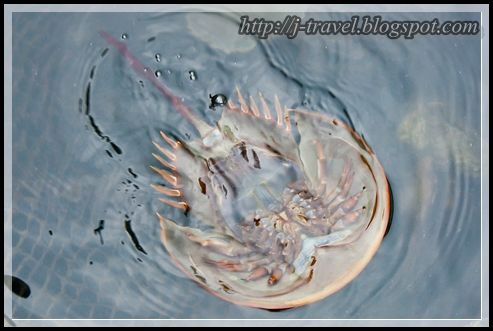
Then we moved to the Horse Shoe Crab...this was the first time I saw the horse shoe swim...that was new to me! Haha!

The boy explain about the Horse Shoe Crab

This was the way the horse shoe swim...

"There are many foreigners settle down here in Langkawi, some of them started the restaurant business or others and own a unique floating house at the Kilim River area..." said the Boatman. Below floating house is owned by a couple of Japanese.

Nice Floating House owned by Japanese couple.

It took about 30 minutes for us to tour around the fish farm, and we continue our journey to the Millions years Bat Cave! The cave is located nearby the Kilim Jetty....

We passed by the Kilim Jetty again...

Related post :
*  My Trip to Langkawi Island on September 2010
*  Grand Continental Hotel at Kuah, Langkawi Island
*  Underwater World of Langkawi Island
*  Sunset Of Cenang Beach (Pantai), Langkawi Island
*  The Lighthouse Restaurant at Tengah Beach (Pantai), Langkawi Island 
*  The Langkawi Cable Car at Langkawi Island.
*  The Famous Sky-Bridge of Mount Machinchang, Langkawi Island. 
*  Restoran Nasi Kandar Tomato at Cenang Beach, Langkawi Island
*  The Kilim Geoforest Park of Langkawi Island
*  The Eagles Feeding at Kilim Geoforest Park of Langkawi Island
*  The Bat Cave at Kilim Geoforest Park of Langkawi Island
*  Wonderland Seafood Store at Kuah Town, Langkawi Island
*  Hole In The Wall Floating Restaurant at Kilim Geoforest Park, Langkawi Island 


The Location Map of the Fish Farm at Kilim River


Xiaomei Chen: Puzhu

Photo © Xiaomei Chen-All Rights Reserved
Hands in Chinese Hakka culture are often a metaphor for the ability to work and survive; a symbol for diligence. "If you have hands, you never beg" the Hakka say.
And so reads a caption under one of Xiaomei Chen's photographs in her Puzhu gallery.

Xiaomei Chen had to choose between a Phd and a camera, and the camera won. Since 2006, she has been documenting human lives with it, using her background in anthropology. She's currently living in the US, and works as a contractor at The Washington Post. Having been a teacher in south China, she's fluent in Mandarin, Cantonese and Hakka.

She embarked on a visual project documenting Puzhu, an obscure and shrinking village of 45 people in south China which mirrors what China has been going through in the past century. Farmers are leaving their land to earn better pay in the big cities such as Shanghai, leaving their centuries-old houses and way of life.

Puzhu In Transition was produced in partial fulfillment of a Masters of Art degree requirement for the School of Visual Communication at Ohio University. It consist of stills, video and a book.

The book is available for sale on Blurb.