Bhutan: Land of Druk Yul

Photograph © Tewfic El-Sawy

I will be on my Land of the Druk Yul photo expedition from September 28 to October 18. A few days in London, then on to Bangkok where I meet the expedition's participants, then we fly off to Paro on Druk Air in the wee hours of October 3.

I have yet to pack all my photo gear, make sure that whatever needs it is recharged and in working order, and figure how to fit everything I need in my carry-on luggage...always an exercise in spatial ingenuity.

By necessity, posts will slow down while I'm traveling, but I'll try to set some "robot" posts before I leave, and if I have reasonable internet connections in Bhutan, I will keep TTP readers appraised of our progress.

The above image of a Cham dancer in Prakhar was “lomo-ized” via Lightroom.

NGS+ liveBooks: All Roads Film Festival


All Roads is a National Geographic initiative supporting films by and about indigenous groups and under-represented minority culture filmmakers. The festival is a multimedia event comprised of cutting-edge film, videos, live music, photography, and art from cultures around the world.

One of the facets of the initiative is the Photography competition which honors four photographers from Argentina, Bangladesh, Afghanistan and Azerbaijan who used their work to advance awareness of the plights of their native countries and drive social change. The photographers will participate in the All Roads Film Festivals in both Washington D.C. (Sept. 25 to 28) and Los Angeles, California, (Oct. 2 to 5), where their images will be exhibited. The winners will be discussing their work during the Global Storytellers program and exhibiting at this year’s All Roads Film Festivals.

In addition to the festival’s programs, the photographers will be in the spotlight in San Francisco, during the Global Storytellers program. Details are of the venue are:

Monday, Sept. 29th, 2008
Reception: 4:30 – 5:30 p.m. (Refreshments & Light Fare)
Lecture: 5:30 – 7:30 p.m.
Adobe Systems Inc.
601 Townsend Street @ 7th Street
San Francisco, California


“Global Storytellers” is hosted by a consortium including the National Geographic All Roads Film Project, Adobe Systems Inc, the Aurora Forum, DataColor, FiftyCrows Foundation and liveBooks.

Multimedia Muse


Three anonymous photographers created Multimedia Muse, a website that aims to rectify the substandard showcasing of multimedia by news websites, and that seeks to increase the "clickability" factor of multimedia projects.

Here's wishing them lots of luck.

Photo~Expedition: Theyyams of Malabar


Having forgotten that I would have little time to blog while on my Land of the Druk Yul photo-expedition to Bhutan in a few days, and even less time to properly announce my first photo-expedition of 2009, I decided to do so today!

The Theyyams of Malabar photo-expedition is specifically structured and timed to allow its members to photograph and document the most spectacular ritualistic dances of Northern Kerala: Theyyam.

Our itinerary will take us to the Malabar region of south India, and along with Malabari villagers, attend the Theyyam performances in local temples. Not only will we attend these unique rituals which are scheduled from February 22 to 25, but we shall also encounter smaller Theyyam rituals deep in the forests of Northern Kerala.

China Town of Malacca

After the Stadhuys Museum, we continue our journey to the China Town of Malacca. This area actually is the Shopping Paradise.

The most convenience way to park your car (if you're driving) is the parking of Memosa Hotel (N2°11.949' E102°15.086'). MYR3.00 per entry. Even you can have a cheaper parking along the road, but it won't be easily for you to get a parking lot within this area.

Memosa Hotel

We visited the Madam King Departmental (N2°11.981' E102°15.088') which is my wife Favorite! I noticed this Popiah stall (N2°11.974' E102°15.084') located outside Madam King always full of peoples queuing.....

I feel the design of this mosque (beside Memosa Hotel) similar to the mosque at Taipei during my visit.....

Below pictures are the street of China Town - Jalan Bunga Raya


You might notice that the TV antennas over here are installed with a long pipe and at least 6-10 meters above the roof, the reason behind is to receive Singapore broadcasting TV channel.


View Larger Map


MY TRIPS - Home

Alixandra Fazzina: Childbirth Perils

Photograph © Alixandra Fazzina/TIME

TIME magazine features a 14-picture essay on the perils of childbearing in Afghanistan. Photographer Alixandra Fazzina traveled to Badakhshan, where a harsh landscape and lack of infrastructure have given rise to an astonishingly high rate of deaths during childbirth. In this far flung area of Afghanistan, for every 100,000 babies born, 6,500 women will die.

I’m sure I won’t be the only one who thinks the above photograph is reminiscent -to use a cliche- of La Pieta, and there are many more in this essay that will move you.

Alixandra Fazzina has spent a decade chronicling war, violence, misery and distress, mainly in Africa and the Middle East. She photographed the notorious Lord’s Resistance Army and their victims in Uganda, the Miya-Miya rebels in Congo, and is currently working on a story about people-smuggling from Ethiopia and Somalia to the Yemen and Saudi Arabia. In addition to her work for British newspapers such as The Sunday Times, Guardian, Telegraph and Independent, her reportage features were published in Newsweek, The New York Times, Stern and Corriere.

TIME magazine's The Perils of Childbirth in Afghanistan

The Museum Of History and Ethnography at Stadhuys, Malacca (Melaka)

2nd day of Malacca Trip

After our breakfast at the hotel, we visited the Museum at Stadhuys. The "Museum Of History and Ethnography".
Entrance fees are MYR5.00 for adult & MYR2.00 for children below 12 years old. Kids below 5 year old are free.
After the entrance, this the first thing you explore.....

The Drainage System of Stadhuys
The drainage system that could be seen around the Stadhuys Complex now was either built during the British era earlier. This huge Stadhuys Complex seemed as though it did not have a drainage system at all during the Dutch era. Only when it was studied to plan the restoration work that it was found many drains criss-crossing in the Stadhuys Complex. This is one of those underground drains that were accidentally found while removing the cement floor.
Obviously the Dutch arranged and built the drainage system before the construction of the Stadhuys. This was typical Dutch architecture. This drain is not functioning now due to to the construction of an additional structure that somehow has blocked the flow.
Laterite blocks were lined up and cemented with lime plaster to form the drain. Then the drain was covered with granite slabs and tightly held together by clay. This part if the drain was purposely exposed to show the drainage system that existed in this building. - Sources from Stadhuys Museum

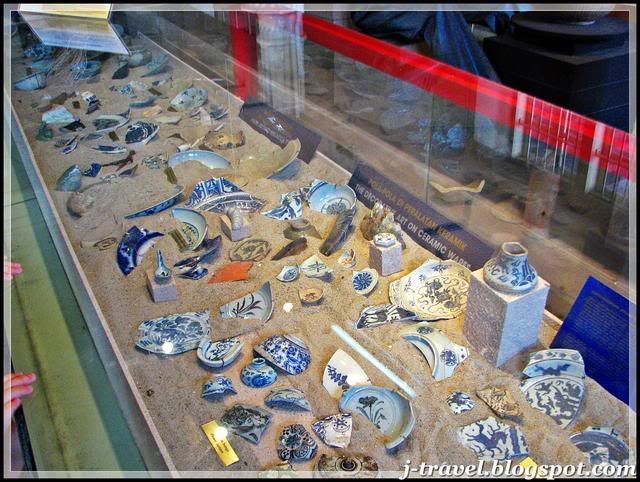
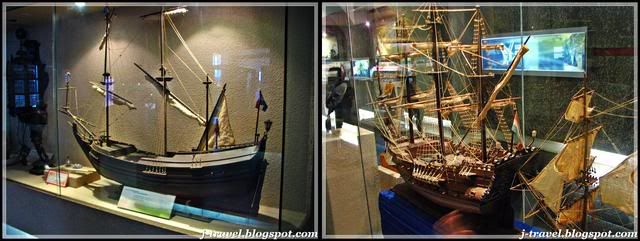
The pictures of the museum for sharing......


Sukhothai and Sawankhalok Ceramics


The pottery and ceramics industry has existed for a long time in Thailand. Because it depended on royal patronage, the production of Thai wares was localized in nature, dependent in the rise and fall of the state powers, and was therefore known by the location where they were made.
In the middle of 13th century, a new kingdom was established in Sukhothai in Northern Tailand, and within 50 years, especially under King Rama Khamberg, the Empire of Sukhothai had become a cultural, trade and administrative center. This encouraged the growth of the ceramics industry to meet domestic needs as well as for export purpose. At first, the kilns in Sukhothai produced ceramics, which were low quality due to the rough clay found around the city. Sukhothai ceramics can be categorized into white wares and under glaze painted wares.
During the middle of the 14th century, a new ceramics center was open in Sawankhalok, not far away from the city of Sukhothai. The clay found in this area was finer quality that Sukhothai, enabling the production of better ceramics. The Sawankhalok ceramics industry grew, producing many varieties of ceramics, including artistic, decorative wares. The ceramics were not only white in colour but also brown and green, with an under glaze. - Sources from Stadhuys Museum


After this, we proceed to another building on the right........


The statue of Cheng Ho


Can you see the "Clock Tower"?

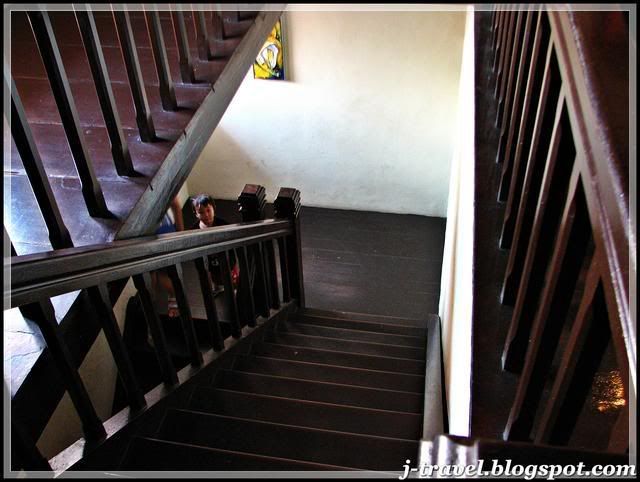
After the stair case below, we finish our visit for the Museum.

Related Melaka post :-
* Panaroma Malacca (Melaka) Tour Bus
* An Evening at Malacca (Melaka)
* Stadhuys, Malacca (Melaka)
* St. Paul's Church, Malacca
* Aldy Hotel, Malacca (Melaka)
* Jonker Walk Night Market, Malacca (Melaka)
* Ole Sayang Nyonya Food Restaurant, Malacca (Melaka)
* Malacca (Melaka) River Cruise
* Dim Sum Restaurant at Malacca
* Special Homemade Herbal Tea at Malacca
* Portuguese Village, Malacca (Melaka)
* Famous Malacca's Popiah
* Hotel Equatorial, Malacca
* Taiwan Beef Noodle Malacca
* Nyonya Suan Restaurant, Malacca
* Mahkota Parade, Malacca
* Malacca (Melaka)


MY TRIPS - Home