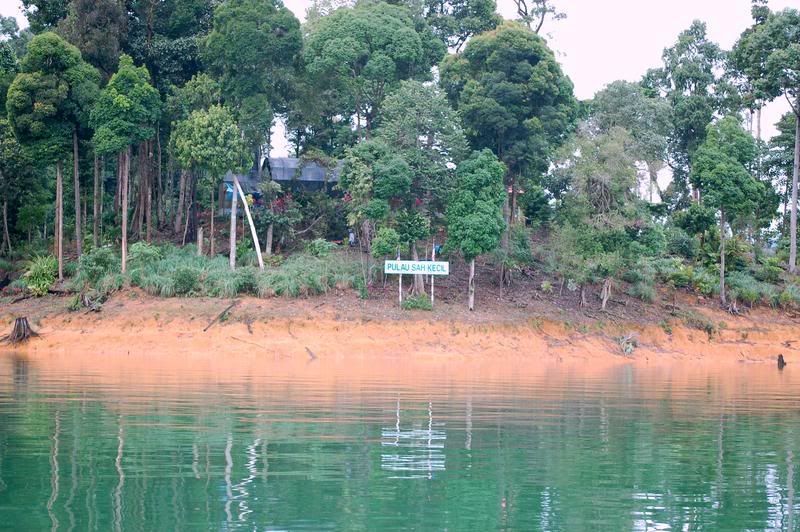
Kenyir Lake, Terengganu.

The Explorers's journey continue.....
Approx. 527KM away from Johor Bahru to Kenyir Lake. They (3 families) check in to Kenyir Lake View Resort (N5°08.286' E102°48.663') around noon time. 3 days 2 nights for MYR468.00 person as package rates (inclusive of meals).


After settle with their lunch in the resort, they took their free time to walk around the resort for the first day.


Day 2
Everyone was excited and wake up early in the morning to enjoy their breakfast and start the boat cruise whitin the lake.

The modified Kancil as free transport from resort to Jetty.....


Jetty

The lake is too beautiful to be true! But...luck was not on their side because of cloudy day.

Beauty Scenic during boat ride


First stop - The Saok Waterfall of Kenyir Lake (N5°04.985' E102°46.734')


Look at the beautiful waterfall!


Children are TOO happy to see this waterfall.....
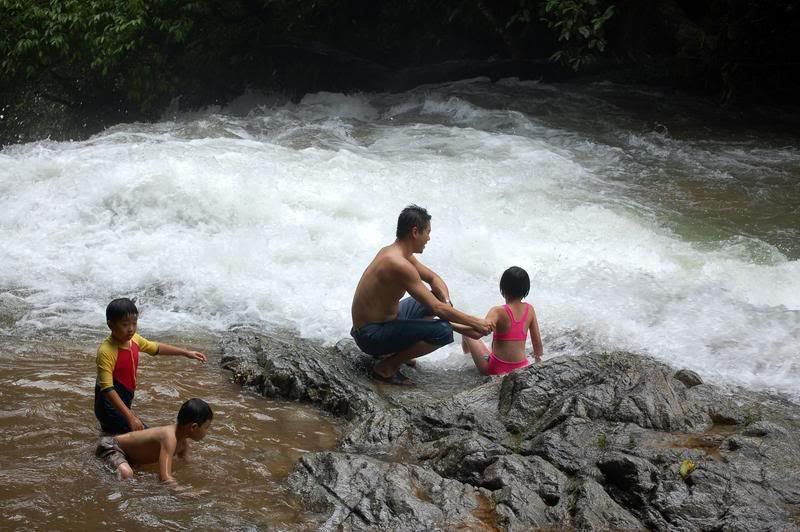
After the waterfall cold water, they continue the Second stop.......

Look at the fish!


Everyone was exhausted after the boat ride but with lovely smile on their faces.....
They went back to the resort for their dinner and take good rest to the third day long journey back to Johor Bahru.
Along the journey back, they meet the Flood of the year (December 2007) at Pekan. The water level was to high to pass through and also force them to de-route from Pekan back to Kuantan, and drive through KL to Johor Bahru. Additional 249KM!
But they are enjoy their slow drive and stop by Seremban for the Famous Authentic Baked Crab dinner!


MY TRIPS - Home


Ami Vitale: NGM: Kolkata Rickshaws

Photograph © Ami Vitale-All Rights Reserved

"The strategy of drivers in Kolkata—drivers of private cars and taxis and buses and the enclosed three-wheel scooters used as jitneys and even pedicabs—is simple: Forge ahead while honking. There are no stop signs to speak of." And so starts Calivn Trilin's essay on Kolkata's rickshaws in the April issue of National Geographic.

I thumbed through my fresh-off-the-press National Geographic magazine, and stopped slack-jawed at pages 92-93...a double spread of Ami Vitale's magnificent photograph of a rickshaw puller, S. K. Bikari, who regularly pulls a pair of girls to school in Kolkata, yet rarely sees his own five children back home in the state of Bihar...one of the poorest states in India. Although this photograph may be partially posed, I frankly don't care. I just find all its elements to be just right....yes, even the woman intruding on the scene from the right. The two schoolgirls, in their pristine uniforms, look bored (or uncomfortable) while Bikari is on the verge of overtaking some obstacle on the left. Ami Vitale's is a wonderful photographer, and the rest of her photographs live up to her reputation...but it's this one that I prefer. Naturally it looks better in print form.

I had already posted on TTP on Kolkata's rickshaws, and it seems from the National Geographic article that the city hasn't yet been able to ban them from its streets. Again, the great performance of Om Puri as the rickshaw puller in City of Joy comes to mind whenever I come across such photographs.

The National Geographic did a great job with this subject...however I must say that the video with Ami's narration could be improved upon.

Ami Vitale's Kolkata Rickshaws Photography

Ami Vitale's Video

Calivin Trillin's Kolkata Rickshaws Essay

A Pilgrimage Special: Peaceful Tibetans

The other day, I caught on TV, violence in Tibet. I checked the net and it was reported that demonstrators rampaged through Lhasa resulting in 10 deaths in this supposedly largest and most violent protests against Chinese rule in nearly two decades. The death toll a week later was reported to have reach 99. I have seen many Tibetans in Bodhgaya the last time I visited Mahabodhi Temple and the group there looked like a docile, peaceful group. Then, it could not cross my mind that Tibetans could come to this violent stage. The world is sometimes rather confusing. Somewhere the Dalai Lama was said to have been behind the unrest and elsewhere, he was reported to have hit back at Chinese leaders and Tibetan radicals by threatening to resign if violence in Tibet escalated and yet, there he was again said to be against the boycott of the coming Olympics as well as to have asked his people to live side by side with the Chinese. In one of my trip overseas, I have heard someone commented that Tibet is rich in minerals and there lies the tussle to free and not free Tibet...
Peaceful looking Tibetans at Bodhgaya Temple, Bodhgaya, India...


TTP Recap of the Week

Aaaaargh...I always forget tp post this weekly recap! For your convenience, here's the past week's (March 10-16, 2008) most read posts on TTP:

Photo Contests: Grabbing Your Rights?.
Rumors of a Canon 5D Mark II?
Altars of the Zapotecs

Michael Wolf: Hong Kong

Photograph © Michael Wolf-All Rights Reserved

Michael Wolf is a German photographer who studied at UC Berkley and at the University of Essen. He has been living and working as a photographer and author in China for ten years.

In addition to a wide spectrum of publications for international magazines, three books by him on China have been published, and he has been deeply involved with the topic of vernacular culture for many years. His most recent work deals with the issue of the cultural identity of the city of Hong Kong.

There are many galleries to explore on Michael's website, but the one that intrigued me most is the 100x100 project, in which he photographed 100 residents in their flats (100 rooms each 100 square feet in area) in Hong Kong's oldest public housing estate. Each of these photographs tells us a story...about the persons inhabiting the tiny space, their taste in furnishings, and even their income level.

Hong Kong's oldest (Shek Kip Mei Estate) public housing estate was the one photographed by Michael Wolf, and its buildings were condemned in 2006 and torn down.

Michael Wolf's 100x100

Michael Wolf's Website

Reuters: Iraq War


Reuters, in partnership with multimedia studio MediaStorm, has published a multimedia feature to observe the fifth anniversary of the U.S. invasion of Iraq. The feature is laden with photos, maps and videos, along with interviews with three Reuters journalists, including photographer Goran Tomasevic (who was featured on TTP).

I wonder if this somber anniversary will be adequately observed by the mainstream media, especially as we have lost nearly 4000 soldiers in the meaningless conflict so far, and far more innocent Iraqis have lost their lives.

And lest we forget:

The photograph above is from the multimedia show, and shows George W. Bush in full military regalia on May 1, 2003 when he announced to the world that major fighting in Iraq was over.

Reuters' Bearing Witness: Five Years of the Iraq War

Ami Vitale: Frontline: Kashmir


Here's a PBS/Frontline multimedia feature on Kashmir with photographs by Ami Vitale. It's not a new feature, but I thought it timely as I am traveling to this area in July.

Kashmir has been described as a paradise on earth but it's a disputed area that has seen more than its share of violence and bloodshed in recent years. Indians insist Kashmir is an integral part of their country, and without Kashmir, they could not embrace their secular credentials. Indian Kashmir is more than 60 percent Muslim, making it the only state in India with a Muslim majority. Pakistanis say the "k" in "Pakistan" stands for "Kashmir" and that they will continue to offer moral and diplomatic support to the separatists.

However Kasmir has been calm since this feature has been published, and tourists have returned to the area, enjoying the magnificent views and the hospitality of Kashmiris in this paradise on earth.

Frontline's Kashmir slideshow.

Ami Vitale Interview